English
 French
 Spanish


It was found that undeclared allergens remained the leading cause of U.S. Food and Drug Administration (FDA) food recalls, with 13 events in October 2023, according to the recall statistics for the third quarter of 2023.
These recalls highlight the consequence of mismanagement of food specifications within the production and labeling processes. Failure to rightly identify, manage, and declare allergens indicates shortcomings in managing food specifications, posing severe risks to specific consumers and reflecting a systemic issue in ensuring the accuracy of food product information.
Food specifications can act as the guiding principles in the food sector to ensure that the food we consume is safe, consistent, and of high quality. From the ingredients to the packaging, these specifications safeguard consumer health and trust while providing a framework for food manufacturers to meet industry standards. Understanding and adhering to these specifications are fundamental for all stakeholders in the complex food supply chain.
Defining Food Specifications
Specifications outline the attributes and criteria pertaining to raw materials, finished products, packaging materials, and their designated usage parameters. They function as documents enabling producers and consumers to precisely define the acceptable quality and characteristics of a particular item while also specifying what doesn’t meet those standards.
This can furnish the role of an agreement between the food manufacturer and their suppliers, guaranteeing the delivery of products that align with the mandated standards and become critical in risk assessment, pinpointing potential hazards linked to particular ingredients or production techniques. They become the backbone of the food processing procedures, dictating the requirements to be met while producing, handling, and distributing food products.
Components of a Food Specification
The constituents within a food specification vary depending on the type of food, manufacturing process, target market, consumer demands, and regulatory requirements. Food manufacturers are legally bound to provide adequate product information. This aids subsequent processors and food service operators convey labeling details to end consumers. Here are some common parameters that are typically relevant in the food and beverage industry:
⇒ Food Description
A product description in a food specification outlines the key details of a food item, such as its ingredients, nutritional content, appearance, taste, packaging, and any specific quality standards. It provides a concise summary that helps identify and differentiate the product within the market.
⇒ Supplier and Site Details
Supplier and site information ensures ingredient compliance with quality and food safety standards, minimizing risks tied to unreliable sources or sites lacking proper controls during material sourcing and production.
⇒ Applicability of Regulations
Understanding pertinent legislation is paramount in setting specification parameters for food products and ensuring adherence to evolving regulations concerning ingredients, labeling, and marketing claims.
⇒ Food Safety and Compliance Standards
The set of regulations, guidelines, and protocols that ensure all the processes in the lifecycle from production to consumption meet the safety and quality requirements. This includes adherence to local and international food safety standards and regulations, such as HACCP, FDA regulations, and other relevant food safety certifications.
⇒ Certifications and Claims
These refer to the official recognitions or assertions about a product’s attributes, such as being organic, non-GMO, fair trade, etc to validate specific qualities or practices of the food, like how it was produced or sourced. These details help consumers make informed choices based on their preferences and dietary needs.
⇒ Product Safety Criteria
Stability indicators such as minimum salt content, heat treatment, water activity, and other variables are used for forecasting a food product’s safety and durability over time. Product stability demands evidence-based, scientifically justified assessments.
⇒ Packaging Requirements
Packaging requirements encompass specific information regarding the material used for packaging, the method employed for packaging, and the details included on labels such as net weight (minimum or average weight), volume, or unit count. Additionally, it involves any explicit instructions concerning the handling and transportation of the packaged product.
⇒ Traceability and Origin
This refers to the information regarding where the ingredients come from and the ability to track the product’s journey through the entire supply chain. It includes knowing the origins of components and being able to trace the product’s path from its source to its final destination.
⇒ Ingredient Declaration
The mandatory ingredient declaration becomes an intrinsic part of product specifications and offers a way to suggest how ingredients should be presented on the final product’s packaging. These must have specific names and codes assigned to them by regulatory bodies such as the Food Standards Agency (FSA).
⇒ Additives
Food additives are supplemental substances introduced to food during production or processing to improve its characteristics, such as flavor, texture, appearance, or shelf life.
⇒ Flavorings
Flavorings are substances added to food to enhance or modify its taste, typically derived from natural or artificial sources to impart specific flavors or aromas. The implications of flavoring details as a specification parameter lie in their impact on product labeling and maximum usage rates. They should be mentioned on the label to inform consumers about the presence of added flavorings and any potential allergens or specific ingredients used.
⇒ Composition
Composition, delving into the ingredients and their quantities, drives consistency and quality in food production, influencing taste, texture, and color. Specifying countries of origin and manufacture aids in geographical risk assessment and validating origin or provenance claims.
⇒ Intrinsic Allergens & Allergen Exposure
Manufacturers must disclose intrinsic allergens present inherently in the product and accurately declare potential allergens that may come into contact with food ingredients, adhering to specific government or regional regulations for allergen declaration to reduce cross-contamination risks and mitigate associated hazards in their ingredients, processing equipment, and production procedures.
⇒ Sensory Characteristics
Sensory characteristics serve as measurable sensory attributes such as the anticipated taste, aroma, texture, and appearance, providing precise details and standards for a food product.
⇒ Physiological Properties
The physiological properties of food refers to its nutritional composition, including the definite measurements or ranges of macronutrients (such as carbohydrates, proteins, and fats) and micronutrients (like vitamins and minerals), which impact bodily functions and health.
⇒ Chemical Characteristics
Parameters such as moisture content, water activity, free fatty acids (FFA), peroxide value (PV), pH levels, and Brix denote the quantity of particular chemicals or substances within a food item, crucially ensuring their interactions do not adversely affect product safety, quality, and compliance.
⇒ Microbiological Standards
Food manufacturers are required to set and oversee microbiological standards for their products, outlining permissible levels of spoilage microorganisms and establishing thresholds for specific pathogens or indicator organisms linked to insufficient hygiene practices in the final product.
⇒ Nutritional Information
Nutritional information involves specification parameters including serving size, calorie count, fats (total, saturated, and trans), cholesterol, sodium, total carbohydrates, protein, dietary fiber, and sugars—all requiring clear definition.
⇒ Quality Assurance Protocols
These involve systematic procedures aimed at maintaining uniform quality standards, including techniques for sample selection, conducting quality control examinations, and establishing benchmarks for approving or declining batches based on set criteria. Defect tolerances denote acceptable imperfections in the final product, and food manufacturers must conscientiously adhere to these guidelines by aligning their internal standards accordingly. It establishes acceptable levels of irregularities in the end product.
⇒ Quality Assurance Tests
Release criteria denote the prerequisites a product must meet before being sold or distributed. These involve a range of evaluations, such as physical, chemical, and microbiological tests, conducted to ensure and maintain the standard and consistency of a product’s quality through rigorous quality control assessments.
⇒ Shelf Life
Shelf life represents the duration a product maintains its quality and safety, determined through tests gauging microbial changes and sensory attributes, aiding in setting expiry dates and storage instructions.
⇒ Transport, Storage and Handling
These specifications outline the requisite conditions and protocols for the safe and efficient movement, storage, and handling of food products, such as temperature controls during transit, appropriate packaging materials to prevent contamination, guidelines for storage conditions (such as humidity and light exposure), and protocols for safe handling practices to maintain the quality and safety of the food from production to consumption.
⇒ Ethical & Sustainability Information
Ethical considerations may include fair-trade policies or animal welfare standards, while sustainability comprises issues like deforestation or overfishing. Integration of this information into specifications ensures responsible and safe supplier practices and meets consumer demands.
Challenges in Food Specification Management: Overcoming the Critical Risks
Managing food specifications meticulously involves thorough documentation, precise ingredient measurements, stringent quality control, adherence to regulations, and effective communication across the supply chain, which presents certain challenges such as:
Manual Specification Handling: Traditional methods often involve manual handling of supplier approvals and product specifications, leading to inefficiencies and potential errors in the approval process.
Document Control and Record Keeping: Maintaining the right and updated records for nutrition, formulation, allergens, and certifications can be cumbersome. Without streamlined digital systems, document control becomes challenging, risking compliance issues and label claim validation.
Label Accuracy and Packaging: Unreliable data in label creation due to manual handling or disjointed approval processes can result in labeling errors, resulting in delayed product launches and impacting market competitiveness.
Allergen Handling and Management: Managing allergens in food specification management is very critical and difficult at the same time due to the need for strict segregation to prevent cross-contact, as even trace amounts can trigger severe allergic reactions. Moreover, ensuring accurate labeling and consistent communication throughout the supply chain adds complexity to allergen handling.
Complex Formulation Development: The manual entry required for formulation development can be time-consuming and prone to errors. Automation is necessary for appropriate calculations of product specifications and declarations.
Data-Driven Decision-Making: Lack of transparency and interconnected data throughout the sourcing and production chain hinders efficient decision-making. Identifying specific items from diverse global sources can be tedious without a cohesive data system.
Accurate management of food specifications is critical in ensuring food safety, quality, and regulatory compliance. Failing to manage these specifications can lead to several risks:
- Health Hazards: Incorrect specifications can lead to allergens not being properly identified, leading to severe allergic reactions in sensitive individuals. Additionally, inaccurate specifications might allow harmful pathogens or contaminants to remain in the food, causing foodborne illnesses.
- Quality Issues: Incorrect specifications can impact the taste, texture, appearance, and overall quality of the food product. This can result in customer dissatisfaction, decreased sales, and damage to the brand’s reputation.
- Legal & Regulatory Non-Compliance: Failure to adhere to food safety regulations and labeling requirements can result in legal actions, fines, product recalls, and potential shutdowns of production facilities. Regulatory bodies such as the FDA (Food and Drug Administration) or the USDA (United States Department of Agriculture) have strict guidelines to ensure consumer safety, and non-compliance can have serious consequences.
- Supply Chain Disruptions: Inaccurate specifications can disrupt the supply chain. Suppliers might deliver the wrong ingredients or materials, leading to production delays or the inability to meet consumer demands. This can impact relationships with suppliers and compromise the consistency of the final product.
- Financial Loss: Recalls, legal fines, wastage of raw materials, and reputational damage can lead to significant financial losses for the company. Moreover, if the product’s reputation is tarnished due to poor quality or safety concerns, it may take time and resources to rebuild consumer trust.
- Loss of Consumer Trust: Ultimately, inaccurate food specifications can erode consumer trust. Consumers expect transparency and accurate information about the food they consume. If a company fails to deliver on this, it can lead to a loss of loyal customers and negatively impact the brand’s image in the long term.
It is essential for companies to invest in robust systems and processes to mitigate these risks and ensure the safety, quality, and consistency of their food products.
Digitally Enhance Food Specification Management With Smart Specification
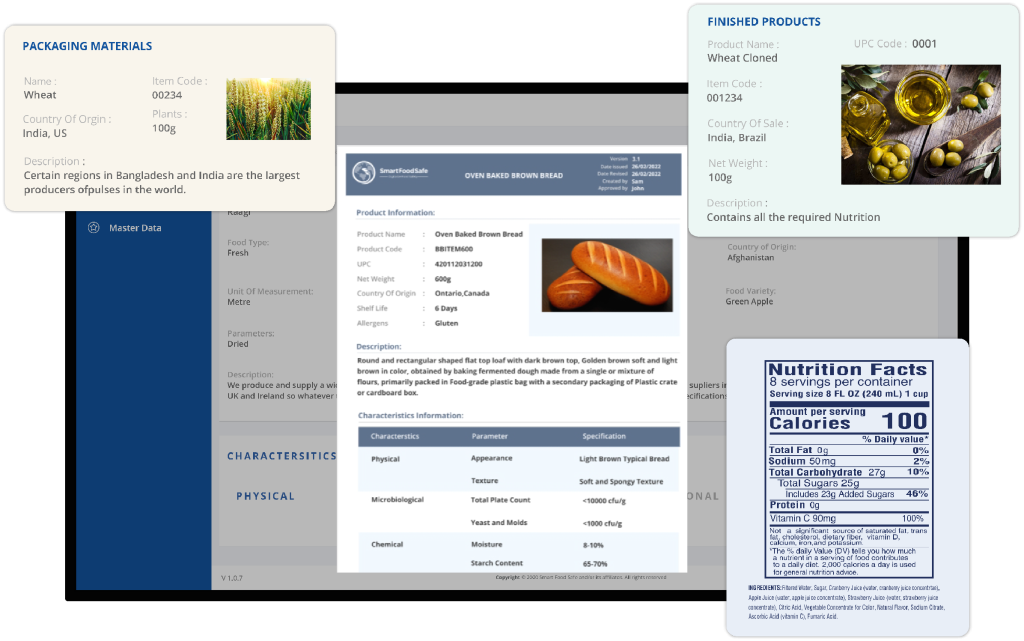
Smart Food Safe’s Smart Specification is a product specification and recipe management software presenting an innovative digital solution to effortlessly streamline the management of food specifications.
Operating as a comprehensive cloud-based tool, Smart Specification aids food manufacturers and suppliers in adhering to the latest regulatory and customer requirements for specification compliance. This dynamic tool empowers food product developers to effortlessly craft and oversee specifications for raw materials, work-in-progress, finished products, and packaging materials. It includes crucial data such as nutritional information, allergen declarations, and other ingredient details.
Key Features of Smart Specification:
Centralized Specification Database: Allows for the storage of all product specifications in one central location. This makes it easier to access, update, and manage product information across the entire organization.
Customizable Specification Templates: Enables users to create and customize templates for different types of food products, incorporating all necessary criteria such as ingredients.
Built-in Characteristics Database: Access pre-existing physical, chemical, microbiological, and nutritional characteristics from our database. Customize characteristics to suit your industry’s digital specification needs and access country-specific allergen information from our integrated global list.
Recipe Information Management: Configure bill of materials by entering or linking raw materials, work-in-progress, and packaging materials. Define their corresponding percentages and tolerances for ensuring recipe compliance.
Version Control and Audit Trails: Maintains a history of changes made to product specifications, providing an audit trail for quality assurance and compliance purposes.
Collaboration Tools: Facilitates collaboration between different departments, suppliers, and external partners. This can include shared access, commenting features, and workflow approvals.
Supplier & Customer Linking: Seamlessly associate suppliers with raw and packaging materials and customers with the final product, simplifying specification management and enhancing material compliances.
Alerts and Notifications: Automated alerts for critical updates, expiring documents, or regulatory changes, helping teams stay informed and take timely action.
Smart Specification revolutionizes the product specification management process for food businesses by ensuring precision, accessibility, and up-to-date specifications. This not only saves time and minimizes errors but also elevates overall product quality and compliance standards.